Parents searching for a single app to teach their child both Arabic and Quran quickly discover that no single app does both equally well. Arabic language learning and Quran reading require different AI models, different content, and different teaching approaches. The best solution is using the right app for each goal. This guide compares the top options and recommends the best combination for your child.
Why One App Cannot Do Both Well
Arabic language learning and Quran reading seem similar on the surface since both involve Arabic text. But the underlying requirements are different:
- Arabic language apps need to teach vocabulary, grammar, conversation, reading comprehension, and writing. The AI needs to understand varied speech patterns and vocabulary usage.
- Quran apps need to teach precise recitation with tajweed rules, memorization with retention, and specific phonetic accuracy. The AI needs to detect subtle pronunciation differences that change meaning in Quranic context.
An app that tries to do both typically does neither well. It either simplifies the Quran component (skipping tajweed) or simplifies the Arabic component (only teaching Quranic vocabulary, which is not conversational).
Top Arabic Learning Apps for Kids
Amal (Best for Arabic Language)
Amal is built specifically for children learning Arabic, with features designed around how children actually learn languages:
- 45 interactive exercise types covering letters, reading, vocabulary, speaking, and writing
- AI pronunciation feedback trained on children's voices
- Adaptive difficulty that adjusts to each child's level
- Physics-based games and Rive animations that make learning feel like play
- Parent dashboard tracking daily progress and specific skills
- Available in 16 languages for non-Arabic-speaking families
Other Arabic Apps
- Duolingo Arabic: Familiar gamified format but uses MSA transliteration, limited pronunciation practice, and a generic teaching model not designed for children. See our detailed Amal vs Duolingo comparison.
- Alifbee: Good basic Arabic content but smaller exercise library and limited AI features compared to Amal. See our Amal vs Alifbee vs Lamsa comparison.
- Lamsa: Arabic content library with stories and games. More of a content platform than a structured learning app. Good supplement but not a standalone curriculum.
Top Quran Learning Apps for Kids
Thurayya (Best for Quran Reading and Tajweed)
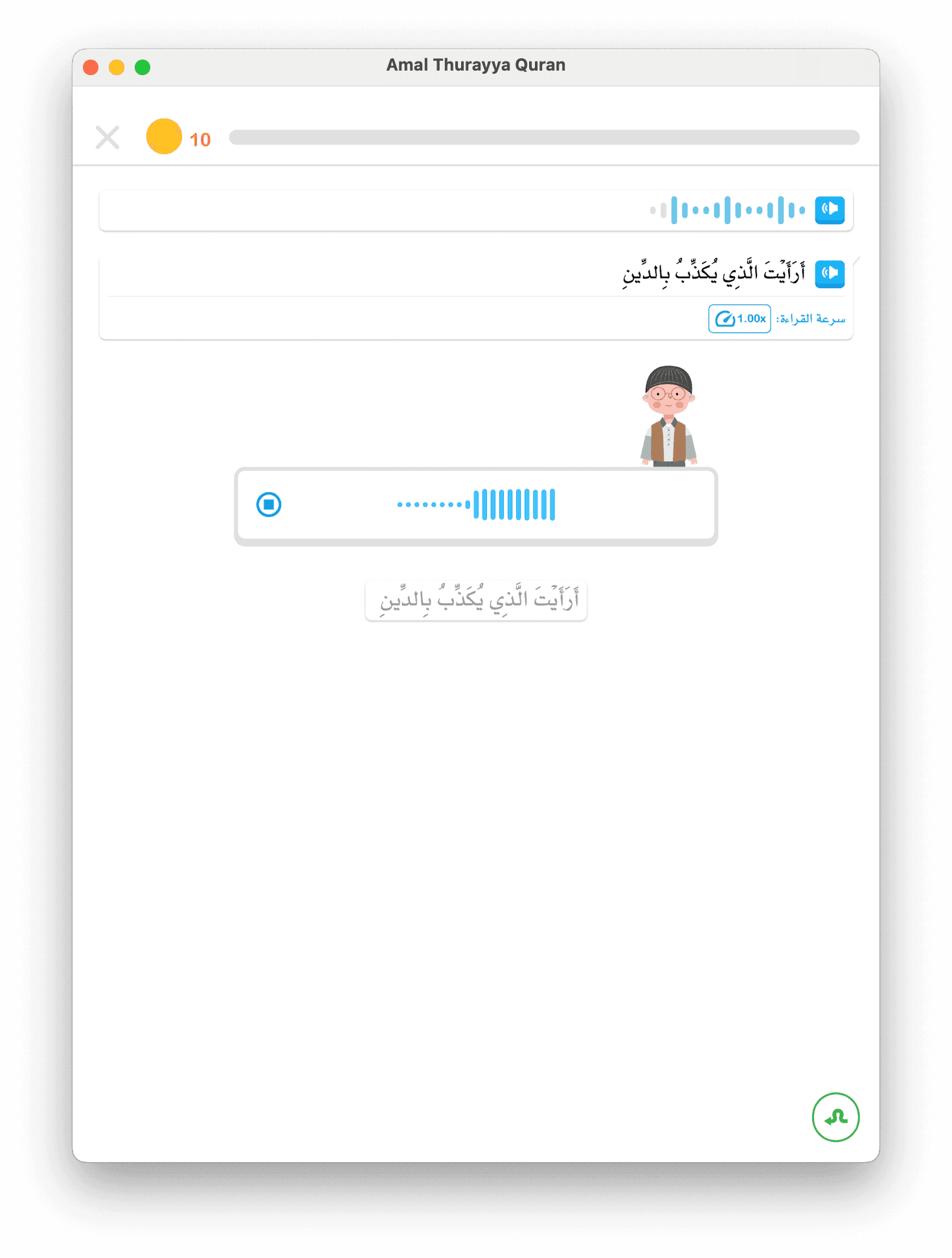
Thurayya is designed for children learning to read Quran with proper tajweed:
- Complete digitized Noorani Qaida with AI pronunciation verification
- Juz Amma memorization with surah-by-surah progression
- AI tajweed engine trained on children's recitation
- Real-time feedback showing exactly which letter or rule needs correction
- Spaced repetition for memorization retention
- Parent dashboard with tajweed accuracy reports
Other Quran Apps
- Tarteel: Good AI recitation tracking for adults and older teens. Not specifically designed for children or beginners. Lacks structured Qaida module.
- Quranly: Solid memorization workflow but limited tajweed-specific feedback. Better for memorization management than tajweed learning.
- Quran Companion: Community-driven memorization with teacher connections. Good for accountability, limited AI feedback.
The Recommended Combination
For most families, the best approach is using two specialized apps rather than one generalist app:
- Amal for Arabic language (15-20 minutes daily): Letters, reading, vocabulary, speaking, writing
- Thurayya for Quran (15-20 minutes daily): Noorani Qaida, tajweed, Juz Amma memorization
Both apps are built on the same platform, share a unified parent dashboard, and are designed to complement each other. The Arabic skills your child builds in Amal directly support their Quran reading in Thurayya, and vice versa.
Choosing Based on Your Child's Needs
- Priority is Arabic communication: Start with Amal. Add Thurayya once your child can recognize all letters (typically after 4-8 weeks).
- Priority is Quran reading: Start with Thurayya. Add Amal to build broader Arabic skills alongside Quran reading.
- Both are equal priority: Start both simultaneously. Use Amal in the morning and Thurayya in the afternoon, or alternate days.
- Budget is limited: Start with whichever matches your immediate priority. Both apps offer free tiers that cover the basics.
Frequently Asked Questions
Can my child use Amal and Thurayya on the same device?
Yes. Both apps are available on iOS and Android. They can be installed on the same phone or tablet, and you can set up the same child's profile in both apps. The parent dashboard shows progress from both apps in one place.
Do I need both apps or is one enough?
If your only goal is Arabic language learning (conversation, reading, writing), Amal alone is sufficient. If your only goal is Quran reading and memorization, Thurayya alone is sufficient. If you want both Arabic language skills and Quran reading, using both apps gives significantly better results than either alone because each app is optimized for its specific domain.
At what age can children start using these apps?
Both Amal and Thurayya are designed for children ages 4-12. Children ages 4-5 work best with a parent nearby for guidance. Children ages 6 and older can typically use the apps independently after the first few sessions. The apps adapt difficulty automatically, so a 4-year-old and an 11-year-old will have appropriately different experiences.
How long before I see results with my child?
With consistent daily use (15-20 minutes per app), most parents report noticeable progress within 2-3 weeks. Letter recognition and basic pronunciation improve first. Reading fluency develops over 2-3 months. Meaningful Quran memorization (first few surahs of Juz Amma) typically happens within the first month. The key factor is daily consistency, not session length.